
How S:US’ Community Fridge Helped John Survive
August 18, 2026
For years, John had something many people quietly take for granted: financial breathing room.
At 47, he was working full time and doing well. He could pay his bills. He could help his mother. He had enough of a cushion to handle life’s unexpected expenses without immediately panicking. After years of financial stability, he had built enough savings to pursue new opportunities and support himself.
He was comfortable. He was secure. He was, by his own description, largely stress-free. Then, suddenly, he wasn’t.
A series of events dramatically changed John’s financial life.
A combination of economic uncertainty and market turndowns quicky eroded the financial security he had worked so hard to build. Bills became difficult to pay. His finances became a constant source of stress. And then, he was unable to pay his roommate for an entire year.
Not being able to pay bills was extremely stressful. But not having money for food was something he had never experienced before. John did not apply for SNAP or EBT benefits, and he was too embarrassed to go to a food pantry.
“I didn’t feel like I belonged there,” John said. “I didn’t want to take food from someone who needed it more than me.”
That is the part of food insecurity we do not always see. And what John couldn’t see was that he needed help as much as the next person.
We often think of food insecurity as something that only affects people experiencing long-term poverty. But we do not always see the person who was financially stable last year. The person helping support a parent. The person paying bills without thinking twice. The person who had a financial cushion until an unexpected setback changed everything.
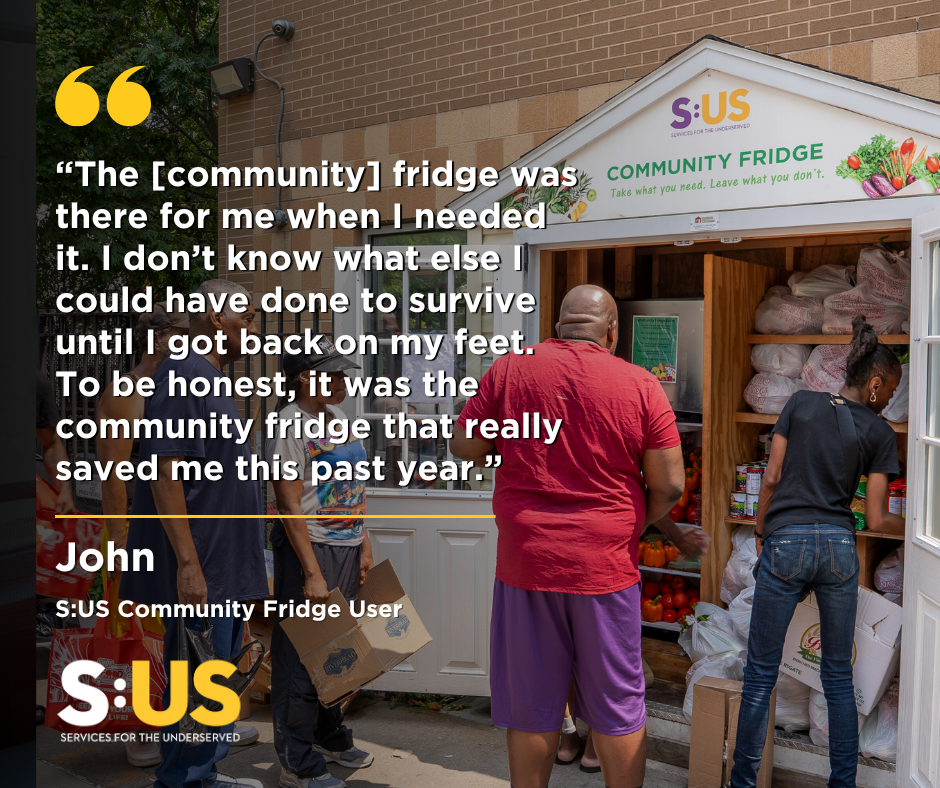
For John, the S:US Urban Farms® community fridge near his apartment became a lifeline.
He had often walked by the fridge and had seen people getting things, but this time, he stopped when he saw a woman putting huge bags of food in it. She smiled and invited him to check it out.
“The [community] fridge was there for me when I needed it. I don’t know what else I could have done to survive until I got back on my feet. To be honest, it was the community fridge that really saved me this past year.”
He discovered a resource that allowed him to access food without paperwork, without judgment, and without having to prove that he was poor enough to deserve help.
Located in neighborhoods across Brooklyn and the Bronx, Services for the UnderServed (S:US) operates four community fridges that help address food insecurity by providing free access to fresh produce and essential items. Rooted in the belief that healthy food is a basic need, the program ensures New Yorkers can access nutritious food with dignity and without stigma.
Today, John is working again and rebuilding the stability he lost. He is catching up on bills, contributing toward rent, and steadily moving toward the goals he once feared were out of reach. But for now, he still uses the fridge as he finds his footing.
And that is precisely why the S:US community fridges matter.
John’s experience reveals an important truth: food insecurity is not always visible, and it does not always affect the people we expect.
Sometimes, food insecurity is the person who was comfortable yesterday.
Sometimes it is the person who works full time.
Sometimes it is the person who helps support a parent.
Sometimes it is the person who simply experienced one devastating year.
Community fridges give New Yorkers something incredibly important: a bridge. A bridge between losing stability and finding it again.
For John, that bridge meant food was available during the hardest year of his life. It meant he could keep going while he searched for work and tried to rebuild the financial security he had lost.
“I’m grateful the fridge was there,” John said.
S:US Urban Farms® community fridges serve New Yorkers from all walks of life. They support people experiencing chronic food insecurity and those facing unexpected hardship. They help older adults on fixed incomes, working families struggling with rising costs, and people who never imagined they would need assistance.
They serve people who may never qualify for benefits such as SNAP.
They serve people who hesitate to seek help because of stigma or embarrassment.
They serve people like John.
Because sometimes the difference between a temporary setback and a deeper crisis is knowing access to food will be there when it’s needed most.
“I have my goals, and a financial strategy. I lost it all, but I will make it all back again, working harder and smarter this time. But I won’t forget the lessons I learned from this experience, and I’m going to have a story to tell to help others who are struggling to know they’re going to be ok. I don’t know who the employees or volunteers are who take care of the community fridges, but I hope they know just how grateful so many of us New Yorkers are. Thank you.”