
From Notorious Landlord to New Homes — Hell’s Kitchen Tenements Get $54M Makeover
October 28, 2026
W42ST
Catie Savage
Four Hell’s Kitchen tenements once owned by notorious landlord Steve Croman have undergone a $54 million transformation, turning a block of deteriorating buildings into renovated apartments for longtime tenants, and New Yorkers transitioning out of the City’s shelter system.

The buildings at 351–357 W45th Street, between 8th and 9th Avenues, were acquired by nonprofit Services for the UnderServed (S:US) in June 2024, following years of pressure from tenants, neighborhood advocates and elected officials over conditions that included mold, vermin infestations and repeated failures to provide heat and hot water.
On Wednesday, October 28, representatives from S:US, city agencies and the development team gathered with residents and elected officials to celebrate the completed project. Of the 80 apartments, 72 underwent full renovations, including two occupied by longtime tenants who temporarily relocated during construction. The remaining eight received more limited upgrades, while 70 of the renovated units are reserved for New Yorkers transitioning out of the shelter system.
Nearly 30 new residents have already moved in, with prospective tenants referred through the City’s Department of Social Services (DSS) and Department of Homeless Services.
Under Croman’s ownership, the buildings accumulated hundreds of housing violations, with the City’s Department of Housing Preservation and Development (HPD) bringing 24 lawsuits against the previous management.


In 2023, HK45/46 Block Association president David Stuart helped bring renewed attention to the properties, working with tenants, neighborhood advocates and elected officials to expose the deteriorating conditions inside the buildings, and drug activity affecting the surrounding block. His efforts helped keep pressure on the City to address problems residents had endured for years.
Stuart’s role was repeatedly acknowledged during Wednesday’s celebration. Manhattan Borough President Brad Hoylman-Sigal and Assemblymember Tony Simone recalled touring the buildings with him and hearing firsthand from tenants. Arlo Chase, Senior Vice President of Real Estate at S:US, credited Stuart with making it clear from the outset that the nonprofit would be expected to be a responsible partner to the neighborhood.
When S:US took over, Chase described the conditions as among the worst he had encountered. “A lot of the doors were off the hinges, bricks were loose, there were mice, vermin, rats,” he told W42ST in December 2024. At 353 W45th Street, pigeon droppings had accumulated throughout the building, mold covered walls, and a squatter was living on the first floor.


Speaking at Wednesday’s celebration, Chase described the project as the “rehabilitation and rebirth” of the four buildings, paying tribute to the tenants who endured those conditions.
“Special shout out to all the tenants who stuck through many, many hard and dangerous and scary years in these buildings,” he said. “If you had seen what we saw and what they lived through, you would be amazed at the transformation.”
Among those tenants is Max Ryan, who has lived in the buildings for 30 years. He recalled how conditions deteriorated during the pandemic, with squatters and strangers entering the buildings prompting him to install his own security cameras. “It became very, very intense and very scary,” he said.
Despite the conditions, Ryan held onto his rent-stabilized apartment, describing such leases as “like gold” in a neighborhood that has changed dramatically since he arrived in 1996.

“So I stuck it out, and I stuck it out — and I’m so glad I did because what’s happening here, I think, is just a beautiful, beautiful solution to what seemed like a problem, and it’s going to help a lot of people,” he said.
Ryan temporarily relocated to an East Village apartment during construction before returning to a fully renovated home. He credited Housing Conservation Coordinators (HCC), David Stuart, local elected officials and fellow tenants with helping push for change.
“Now this is safe housing,” he said. “You never feel scared. You never feel crazy. You never feel like, oh God, is someone following me? Is someone coming into the building?”
Working alongside Highpoint Property Group and SMJ Development, S:US completed extensive renovations, including modern kitchens, new appliances and individual heating and cooling controls. The buildings have also been fully electrified, eliminating the need for gas.
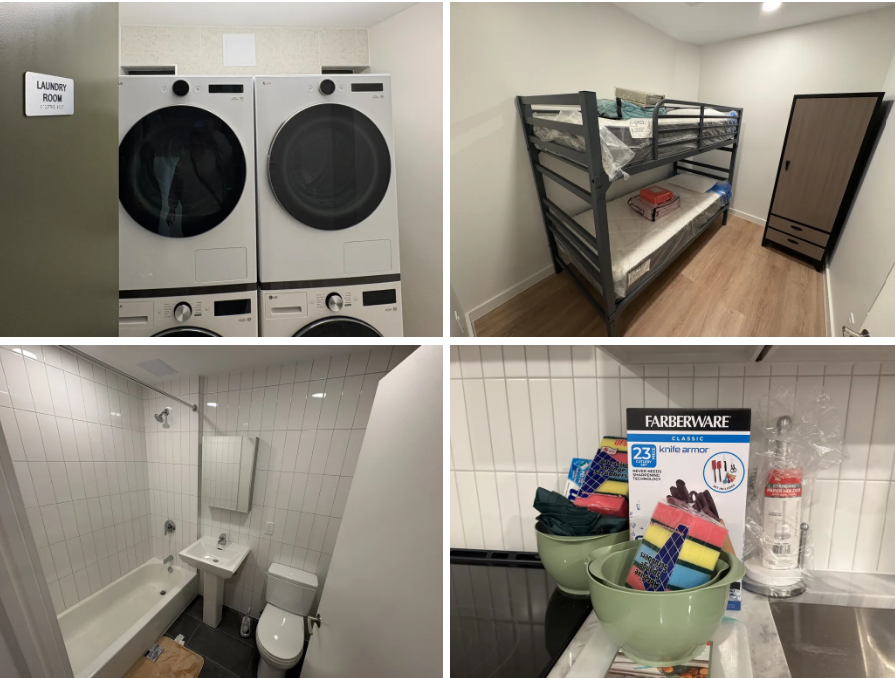
During an October 23 tour, Sherine Agard, Director of Housing Compliance at S:US, showed W42ST a one-bedroom apartment and a larger two-bedroom unit furnished for a family, complete with bunk beds. The 70 apartments reserved for incoming residents are equipped with furniture, kitchenware, cleaning supplies and other essentials, all provided by S:US.
“When I’m doing tours and showing the units to prospective residents, they always ask, ‘Is it staged? Is this a staged unit?’ No, it’s not,” Agard said.
Below street level, formerly cramped cellar spaces have been expanded and connected across the four buildings, creating a communal gathering space, free laundry facilities, a computer room and offices for S:US staff.
On-site property management and support services teams will help residents find employment, access food pantries, enroll in healthcare and register children for school. The buildings also have 24-hour security.

“Just transitioning from shelters, it’s not easy. It’s difficult,” Agard told W42ST. “Sometimes people are just starting all over, so having someone there that they can go to with any questions, concerns is definitely a positive thing.”
The project is part of the City’s Affordable Housing Services (AHS) program, which uses project-based CityFHEPS rental assistance vouchers to provide a reliable income stream, helping nonprofit housing providers secure financing to acquire and rehabilitate buildings.
S:US purchased the four properties for a reported $24 million, followed by the $54 million renovation financed through HPD and Enterprise Community Partners.
“We can use city rental subsidies, like CityFHEPS, and that actually becomes a financing tool, so that folks can get loans and other financing for buildings,” Scott French, administrator for the city’s Human Resources Administration, told W42ST. “So not only then do we house people, it helps generate housing for people in homeless shelters.”

Deputy Mayor for Housing Leila Bozorg described the project as an example of city agencies working with community advocates and nonprofit developers to turn distressed buildings into affordable homes. She also pushed back against the idea that rent stabilization and tenant protections were responsible for the properties’ deterioration.
For a neighborhood that spent years dealing with the consequences of Croman’s ownership, the W45th Street project offers an example of how severely neglected buildings can be brought back into use while preserving homes for existing tenants.
The City is now looking to replicate the model elsewhere. French said DSS is interested in hearing from community boards about other distressed properties that might be suitable for the program as it expands. “We definitely want to do more of this,” he said.